
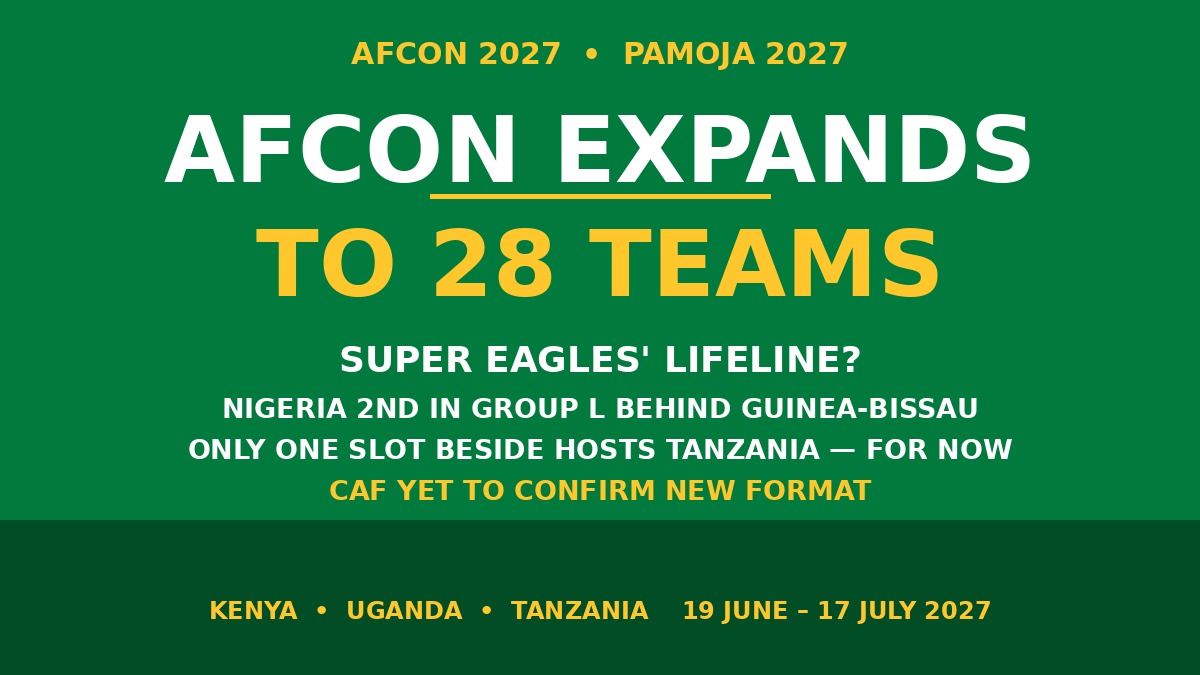
The AFCON 2027 expansion could hand Nigeria’s Super Eagles a second route to next summer’s finals, with reports that CAF is weighing a move from 24 to 28 teams — a change that would soften the qualification maths in Group L, where only one team currently advances alongside co-host Tanzania.
Nigeria sit second in Group L behind Guinea-Bissau, with four points from their two games against Tanzania so far — a 3-1 win in Uyo on 13 November, followed by a goalless draw in Zanzibar four days later. Madagascar are the group’s other side. Under the rules in place now, only the highest-placed of Nigeria, Guinea-Bissau and Madagascar takes the group’s one extra finals place, because Tanzania are already through as co-hosts. Two rounds remain in the March 2027 window, and as things stand, second place in Group L is worth nothing.
AFCON 2027 expansion: what CAF has actually said
CAF president Patrice Motsepe first raised the expansion in March 2026, then confirmed it at a briefing in Johannesburg on 22 July: the 2027 finals in Kenya, Uganda and Tanzania will feature 28 teams instead of 24. Under the format outlined then, the 28 nations will be split into seven groups of four, with the top two from each group plus the two best third-placed teams reaching the last 16.
The tournament runs from 19 June to 17 July 2027 under the PAMOJA banner, the first time three countries have staged it together. Motsepe also confirmed a wider reshaping: another edition follows in 2028, then a four-year cycle, with a Nations League-style tournament planned from 2029.
Why the Super Eagles would benefit
The expansion matters most in the three groups containing a co-host. In Groups D, H and L — home to Kenya, Uganda and Tanzania — only one team besides the host is expected to qualify under the current rules, while the other nine groups send two. A 28-team field could let two qualify from every group, handing the runners-up in those three groups a route to the finals.
Nigeria would be the obvious beneficiary in Group L, but they are not alone: South Africa in Group D and Tunisia in Group H are in the same position, and Guinea head coach Paul Duarte has already called the arrangement unfair. “With two more wins, it is obvious that if our group had the same rules as the others, with two teams qualifying, Guinea would already be qualified for AFCON 2027,” Duarte said. “Despite this injustice, we are not giving up. We will keep fighting for first place. Guinea deserves this qualification.”
The catch: nothing is confirmed yet
For all the talk, CAF has still not published revised qualification regulations for the expanded tournament, and the 24-team format remains the officially published arrangement for 2027. Until a formal decision lands, the extra places are a possibility, not a promise — and Nigeria must keep chasing qualification on the pitch, starting with the March window.
Nine teams are already certain of their place: the three co-hosts, plus six sides who booked their tickets after Matchday 4, among them last edition’s finalists Morocco and Senegal and 2013 runners-up Burkina Faso. The remaining places, seedings and host-city breakdown are all still to be settled.
For Eric Chelle and his players, the message is simple: win in March and the debate does not matter. But if the Super Eagles fall short in Group L, the expansion may yet be the lifeline that carries them to East Africa.
For more on the qualifiers, check today’s predictions.
Photos: SportsBuddy graphic — collage by SportsBuddy.